Common Skin Problems in Kids During Summer
A child's skin is thinner, more sensitive, and more reactive than adult skin and during Hyderabad's intense summer, it faces an extraordinary set of challenges: heat, sweat, humidity, sun exposure, pool water, insect bites, and the playground microbiome of other children. It is no surprise, then, that skin problems are among the most common reasons parents bring their children to Dr. Satyanarayana BH — MBBS, DCH (Gold Medalist), MRCPCH, at Sri Sai Women & Children's Clinic in Gopanpally during the summer months. Most summer skin problems in children are benign and manageable with the right knowledge but some require timely paediatric attention to prevent complications. This guide covers the most common skin problems in children during summer in Hyderabad, with Dr. Satyanarayana's practical advice on recognition and management.
1. Heat Rash (Prickly Heat / Miliaria)
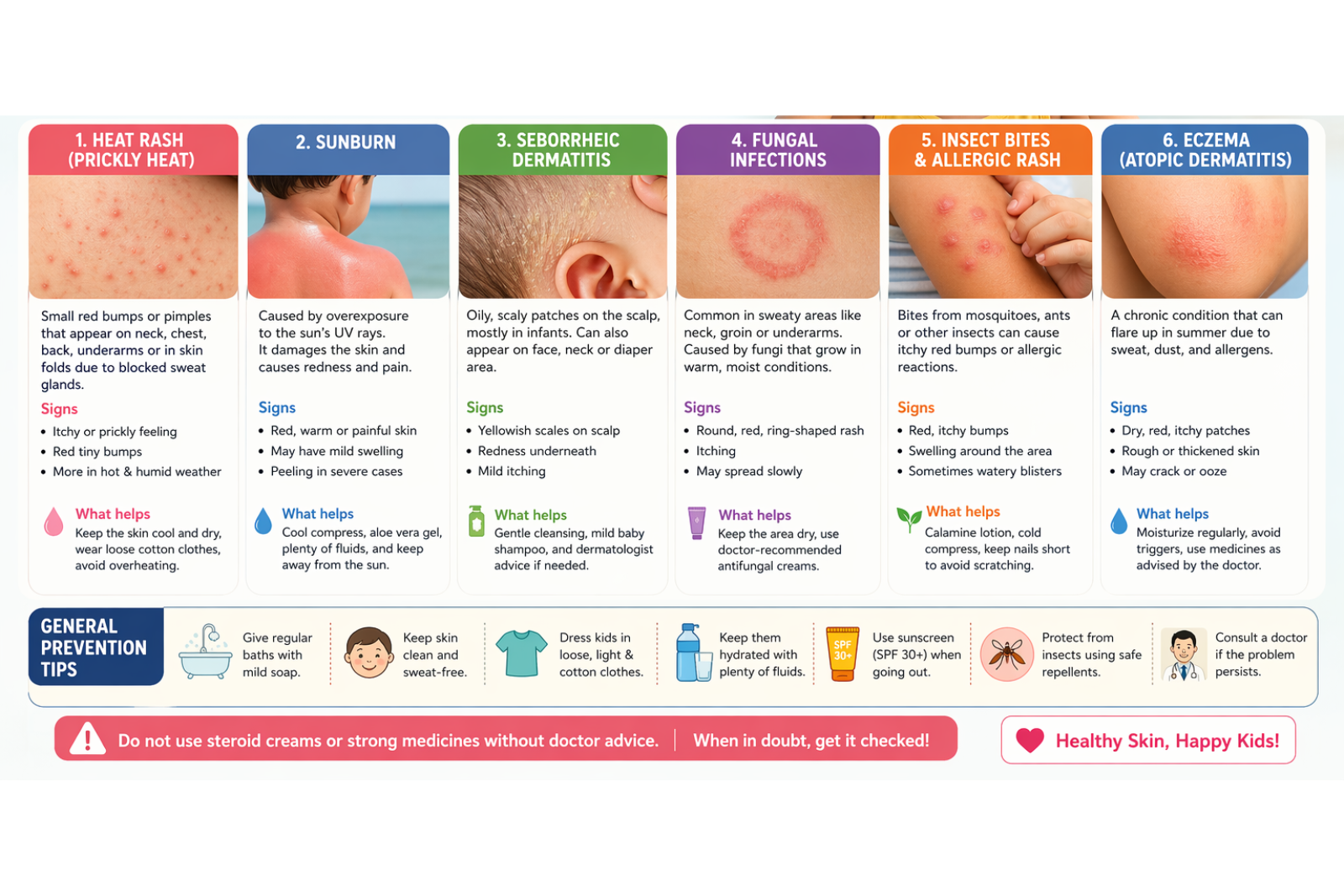
Heat rash — ghhamori is the most common summer skin problem in Indian children and the most frequently seen at Sri Sai Clinic, Gopanpally, during April–June. It occurs when sweat ducts become blocked during hot, humid weather, causing sweat to leak into the skin rather than evaporate. It presents as tiny red or clear bumps most commonly on the neck, chest, back, axillae, and groin that may cause itching or a prickling sensation.
- Miliaria crystallina: Tiny clear vesicles the mildest form; resolves quickly with cooling.
- Miliaria rubra: Red, itchy bumps the most common form; treated with cooling and calamine lotion.
- Miliaria profunda: Flesh-coloured bumps deeper in the skin rare in children; resolves with persistent cooling.
Dr. Satya's Tip: Keep the child in a cool, air-conditioned room during peak heat hours. Cotton clothing, cool baths, and calamine lotion are the mainstays of heat rash treatment.
2. Impetigo — Bacterial Skin Infection
Impetigo is the most common bacterial skin infection in children caused by Staphylococcus aureus or Streptococcus pyogenes. It thrives in summer because heat and sweating create breaks in the skin barrier, and the warm, humid environment allows rapid bacterial proliferation. Impetigo presents as clusters of fluid-filled blisters (bullous impetigo) or honey-coloured crusted lesions (non-bullous impetigo) typically on the face, around the nose and mouth, arms, and legs.
- Impetigo is contagious spread by direct contact with the sores or shared items (towels, clothing)
- Keep the infected child away from school until lesions are crusted and antibiotic treatment has begun
- Treatment: topical antibiotic cream (mupirocin) for limited impetigo; oral antibiotics for widespread infection prescribed by Dr. Satyanarayana
- Keep nails short and clean scratching spreads the infection
3. Fungal Infections (Tinea / Ringworm)
Fungal skin infections tinea corporis (ringworm), tinea cruris (groin ringworm/jock itch), and tinea capitis (scalp ringworm) are significantly more common in summer because fungi thrive in warm, moist conditions. They present as circular, ring-shaped, itchy rashes with a clearing centre and scaly, red border hence the misnomer 'ringworm'. Tinea capitis (scalp infection) causes hair loss in patches with scaling.
- Keep skin clean and dry particularly groin, axillae, and skin folds
- Antifungal cream (clotrimazole or terbinafine) effective for most body ringworm; prescribed by Dr. Satyanarayana
- Tinea capitis requires oral antifungal medication do not treat with topical creams alone
- Change to clean, dry clothes daily; wash clothes frequently in summer
- Do not share towels, combs, or clothing with the affected child
4. Chickenpox (Varicella)
Chickenpox caused by the varicella-zoster virus peaks in India's spring and summer months (March–May). It presents as an itchy rash that starts on the face and trunk, quickly spreading to cover the body with crops of fluid-filled blisters at different stages simultaneously. In children, chickenpox is usually mild but complications including secondary bacterial skin infection (impetigo) and, rarely, chickenpox pneumonia or encephalitis can occur. Chickenpox is preventable the varicella vaccine is available at Sri Sai Clinic, Gopanpally.
- Chickenpox is highly contagious spread through respiratory droplets and direct contact with blisters
- The child is contagious from 1–2 days before the rash appears until all blisters have dried and crusted
- Treatment: paracetamol for fever and discomfort; calamine lotion for itch; keep nails short to prevent scratching and secondary infection
- Antiviral medication (acyclovir) recommended for older children, adolescents, and immunocompromised patients; discuss with Dr. Satyanarayana
Do NOT give aspirin to a child with chickenpox, it can cause Reye's syndrome. Use paracetamol only.
5. Insect Bites and Reactions
Mosquito, ant, bee, and wasp bites are very common during summer and monsoon in Gopanpally and Nallagandla. While most insect bites cause only local reactions (redness, swelling, itching), some children develop more pronounced allergic reactions or secondary infection from scratching.
- Apply ice or cold pack immediately to reduce swelling
- Antihistamine cream or oral antihistamine (cetirizine) for significant itching
- Trim children's nails short to prevent scratching that leads to secondary infection
- Seek immediate care for signs of anaphylaxis (difficulty breathing, facial swelling, hives spreading over the body) after a sting
- Mosquito repellent with DEET or picaridin is safe for children over 2 months — use as directed
6. Sunburn in Children
Children's skin is more susceptible to sunburn than adult skin and sunburn in childhood is a significant risk factor for melanoma in later life. In Hyderabad's intense summer sun (UV index often reaching 'very high' or 'extreme' by 9–10 AM), sun protection for children is not optional.
- Apply SPF 30+ broad-spectrum sunscreen (physical sunscreen with zinc oxide or titanium dioxide is preferred for young children) 20 minutes before outdoor activity
- Reapply every 2 hours and after swimming
- Limit outdoor play between 10 AM and 4 PM
- For sunburn: cool water bathing, aloe vera gel, paracetamol for pain, see Dr. Satyanarayana if blistering or extensive
7. Eczema (Atopic Dermatitis) Flaring in Summer
Children with eczema often experience worsening during summer sweat irritates the skin, heat increases inflammation, and pool water (chlorine) can be a trigger. Management includes: cool baths with gentle soap-free cleanser; moisturizer applied immediately after bathing; avoiding known triggers; and consulting Dr. Satyanarayana at Sri Sai Clinic, Gopanpally, for flare management with appropriate topical steroids if needed.
Internal Links
- Allergy and Skin Condition Care — Sri Sai Clinic Gopanpally
- Chickenpox Vaccine at Sri Sai Clinic Gopanpally
- Skin Infection Treatment for Children — Dr. Satyanarayana Gopanpally
- Book Appointment for Child Skin Problem Gopanpally
Conclusion
Summer skin problems in children are common, diverse, and in most cases very manageable with the right knowledge and timely treatment. At Sri Sai Women & Children's Clinic in Gopanpally, Dr. Satyanarayana BH provides expert evaluation and treatment for the full spectrum of paediatric skin conditions from heat rash and impetigo to eczema flares and chickenpox. With 16 years of paediatric experience and both DCH (Gold Medal) and MRCPCH qualifications, Dr. Satyanarayana delivers the specialist care every Hyderabad child deserves. Serving families across Gopanpally, Nallagandla, Tellapur, Serilingampally, and Hyderabad.
Child's skin problem? Book an appointment with Dr. Satyanarayana at Sri Sai Clinic, Gopanpally. Call: +91-9347761835